
Legacy of Kings Idle Builder Maps and Guide
Fully uncovered and explored maps for Legacy of Kings: Idle Builder with descriptions, locations of resources, wonders and landmarks, towns, gems and gold veins.
Legacy of Kings Idle Builder Map List
| Map | Map description |
|---|---|
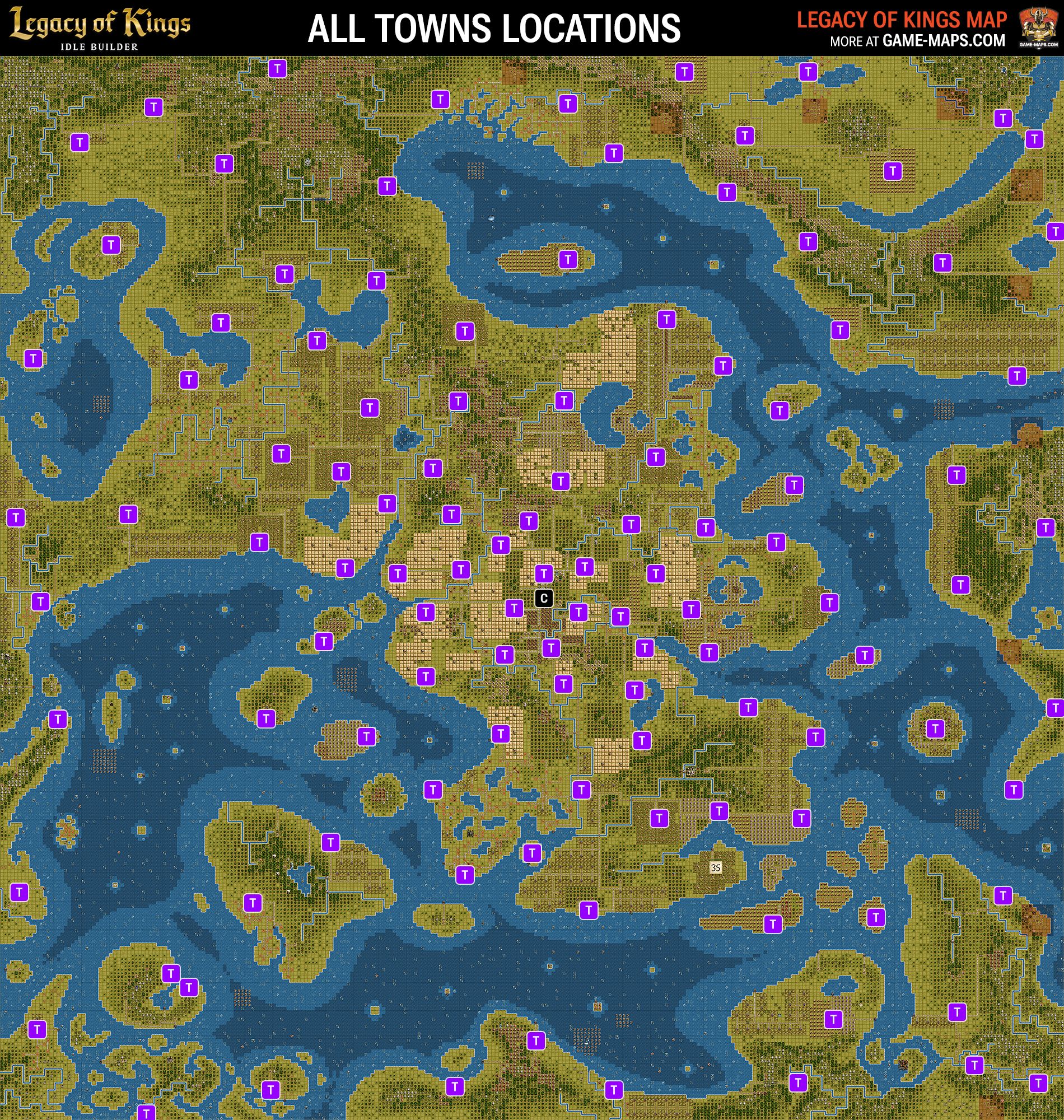
All Town and Capital Locations MapDiscovered Legacy of Kings Map showing location of all Towns and Capital in the center, Legacy of Kings Idle Builder Maps. |
|
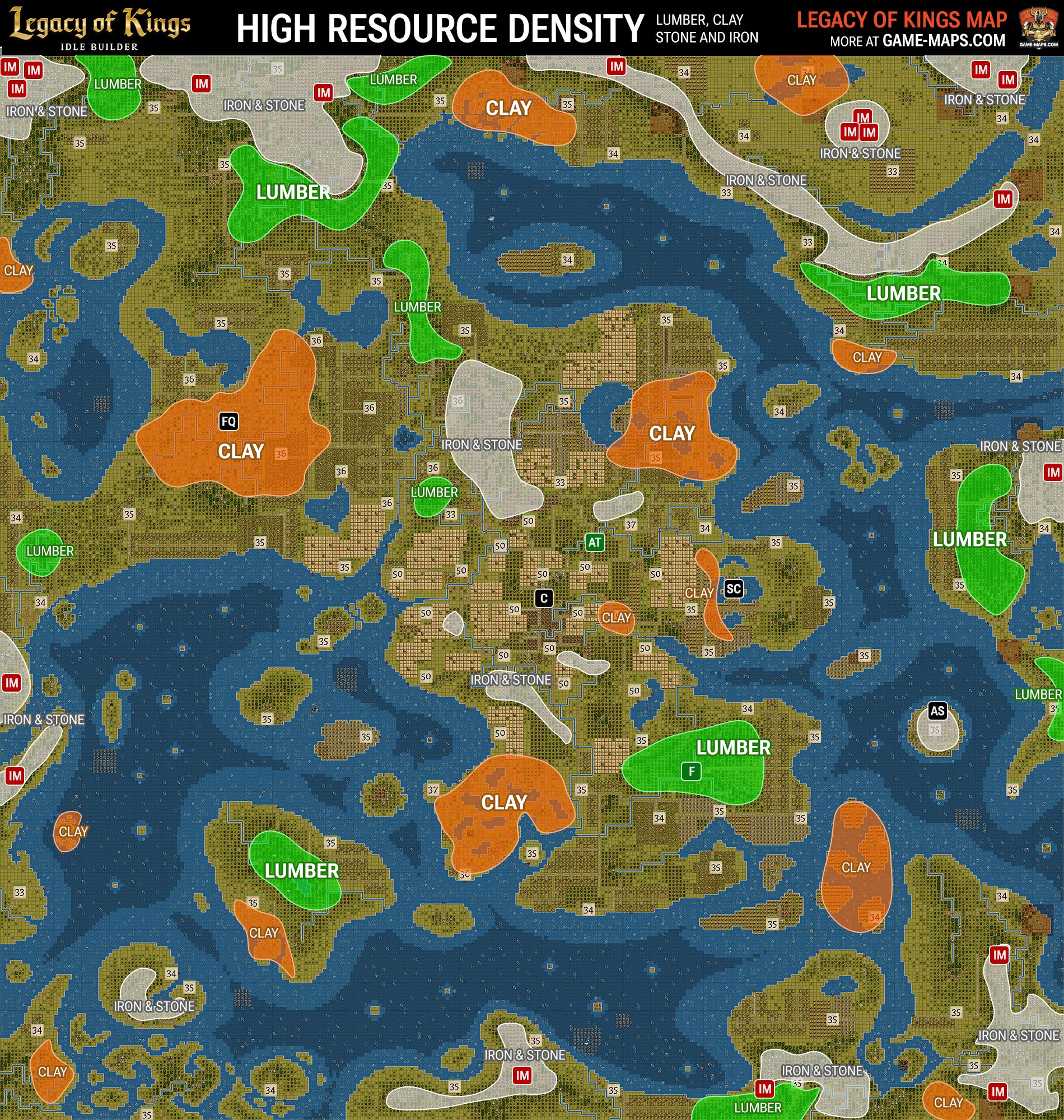
Resource Distribution and Density MapLocation map featuring the highest density of resources like Lumber, Clay, Stone and Iron, Legacy of Kings Idle Builder Maps. |
|
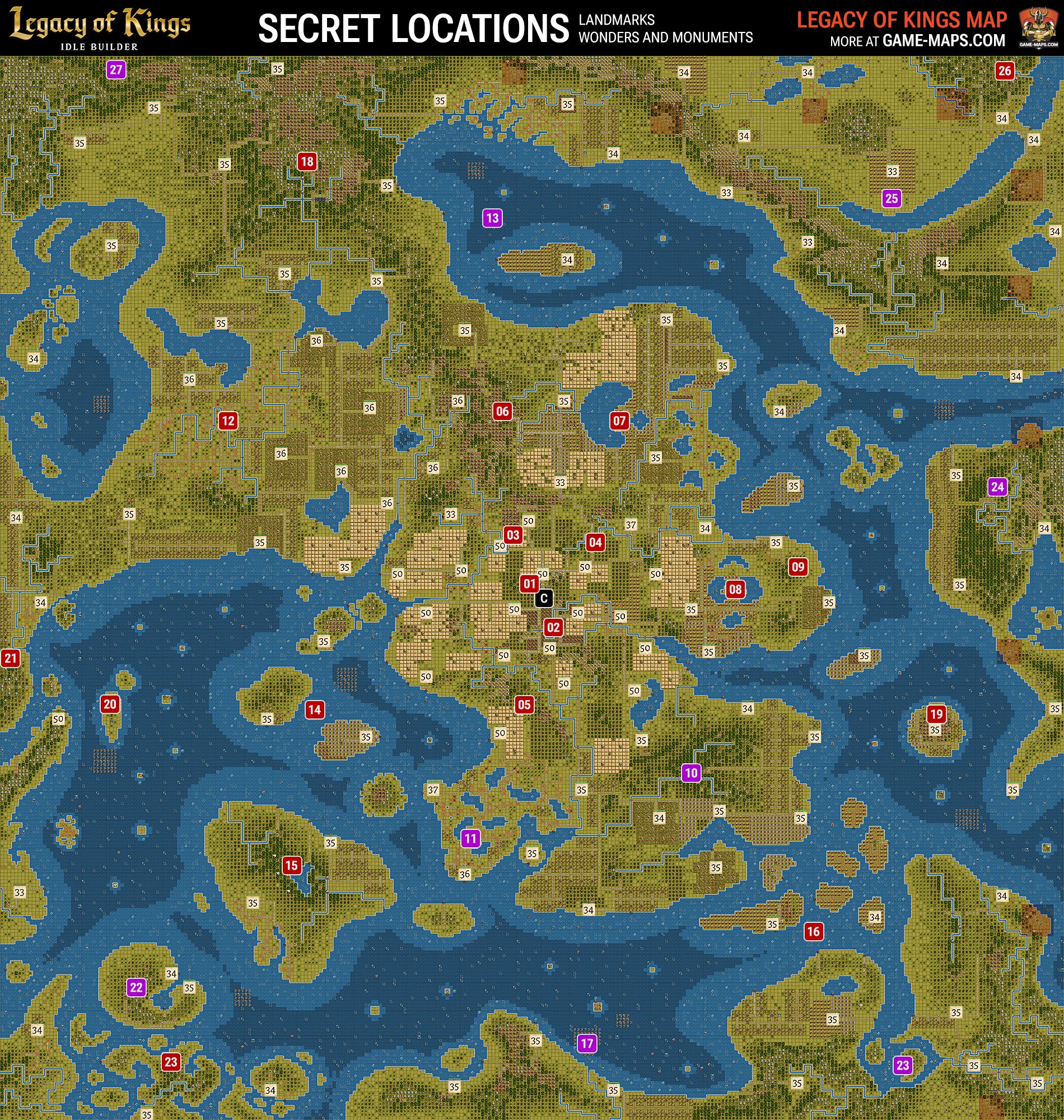
All Secret Locations MapEvery hidden spot, including Landmarks, Wonders, Monuments and unique Points of Interest with description and bonuses, Legacy of Kings Idle Builder Maps. |
|
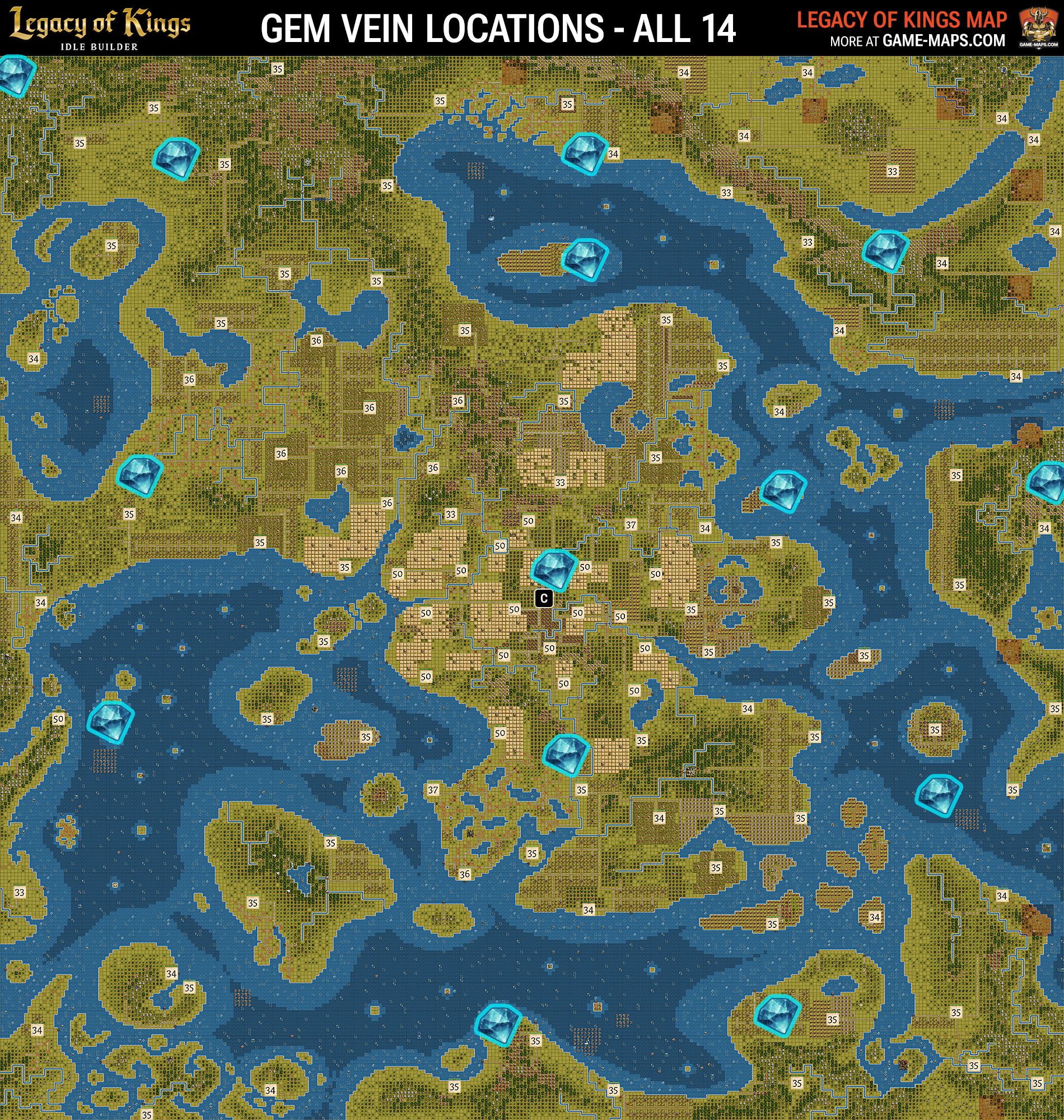
Gem Locations MapMap of all Gem Vein locations, Legacy of Kings Idle Builder Maps. |
|
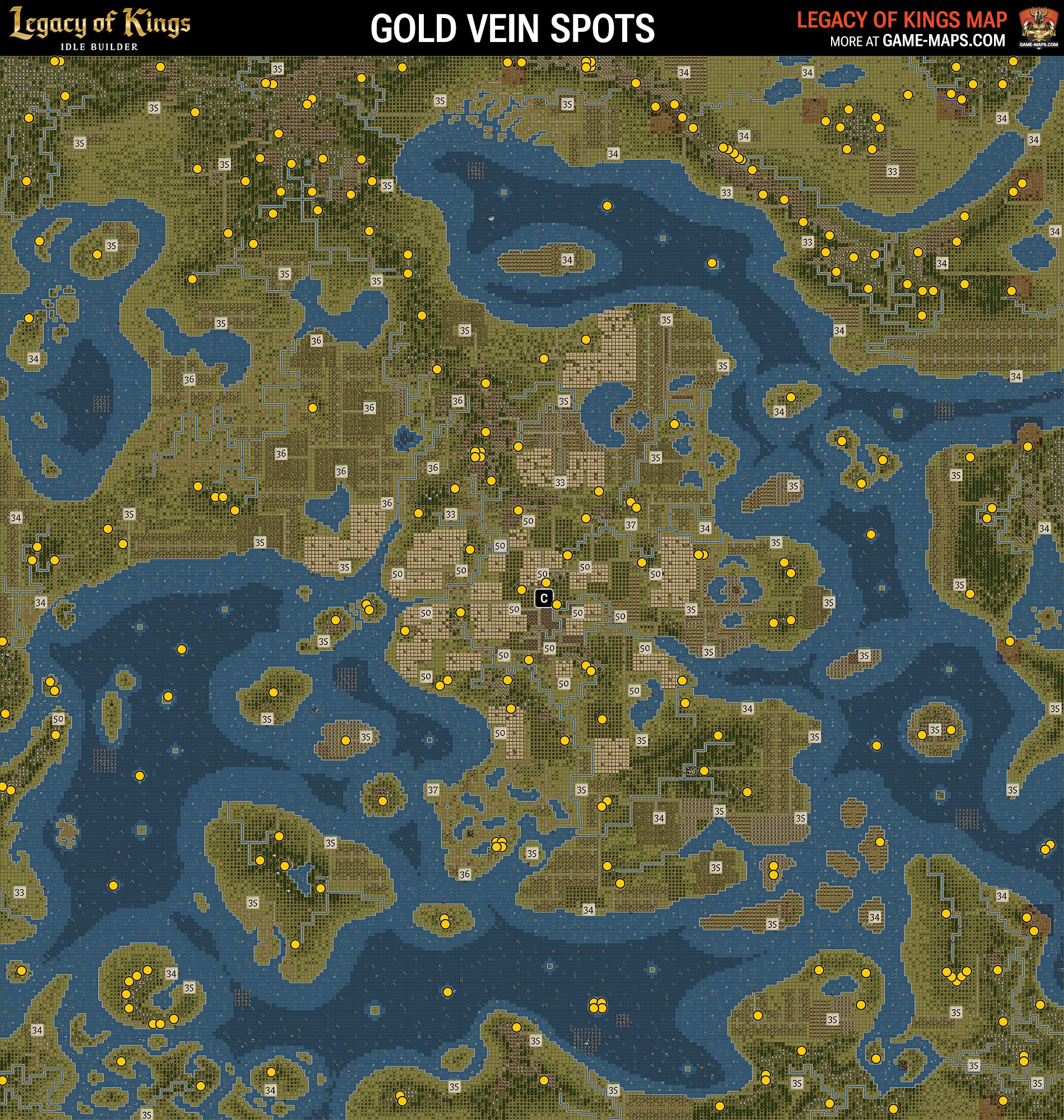
Gold Vein Locations MapMap of all Gold Vein locations for Gold Mines, Legacy of Kings Idle Builder Maps. |
|
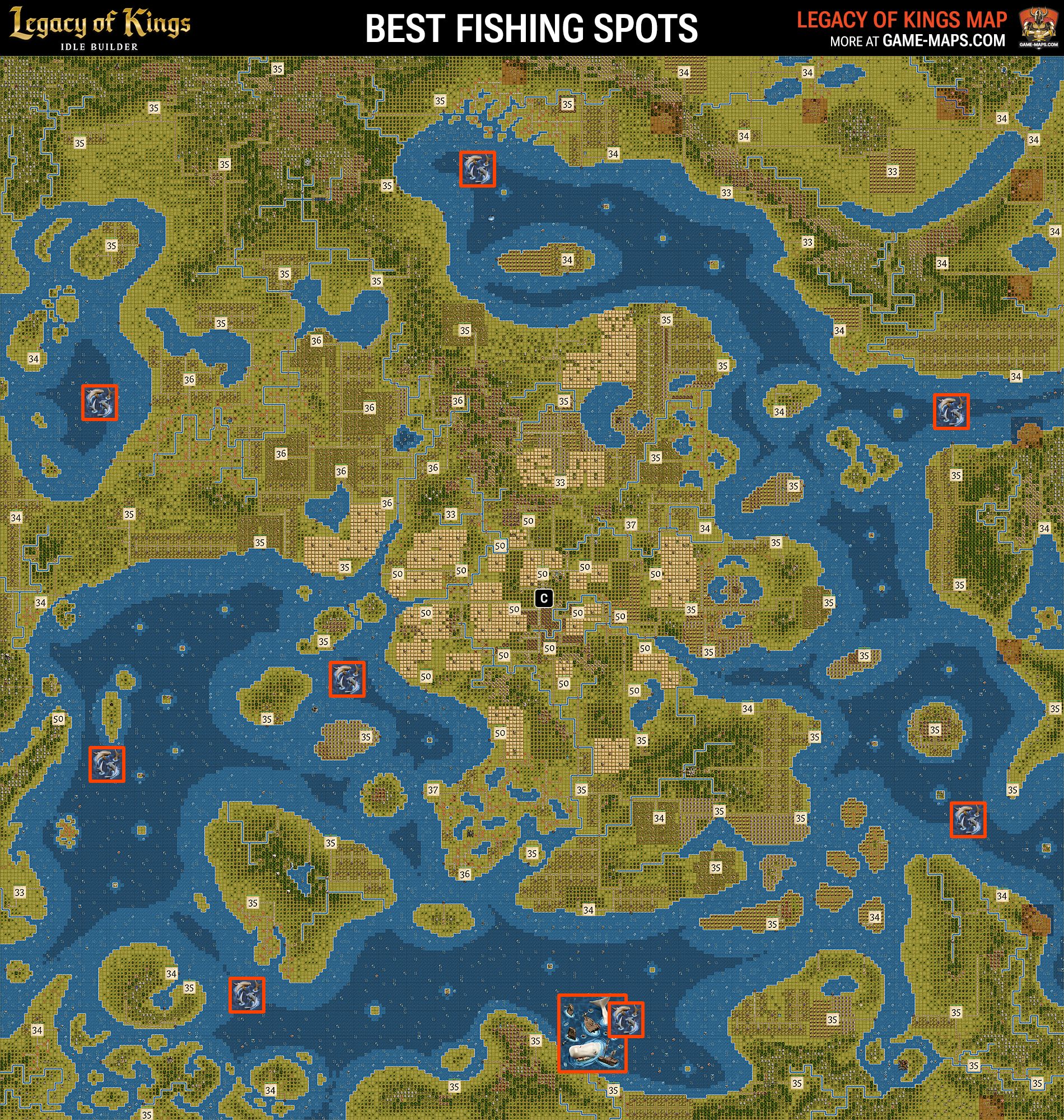
Fishing Spots MapThe best Fishing Spots map for Legacy of Kings Idle Builder Maps. |
|
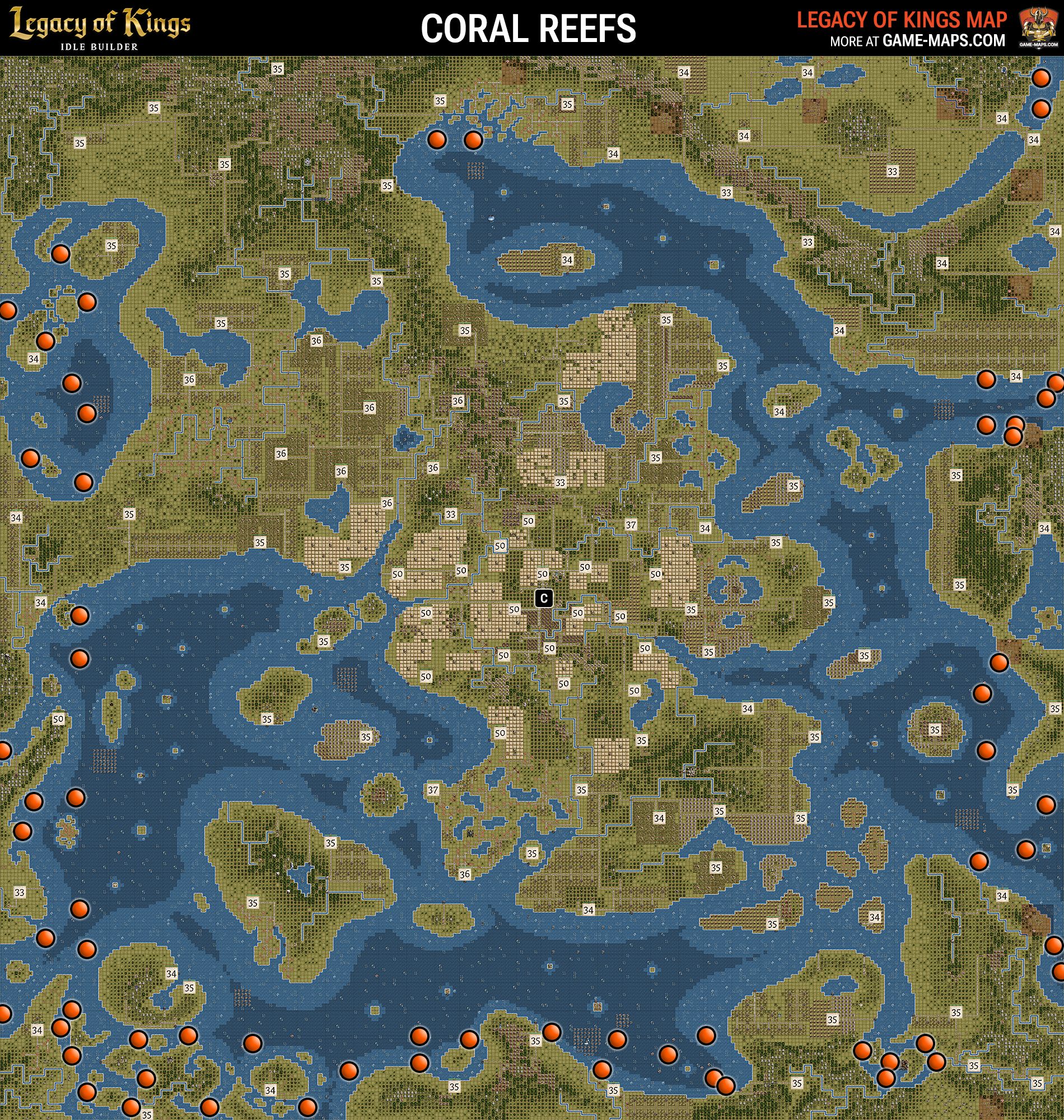
Coral Reefs MapMap of all Coral Reefs and Pearl Hunters locations, Legacy of Kings Idle Builder Maps. |
How to play Legacy of Kings: Idle Builder? Quick Game Guide
This guide hits the most important tips you'll need, but it doesn't claim to cover everything. Legacy of Kings: Idle Builder gets pretty complex as you go, so half the fun is figuring it out step by step. Make sure to read the in-game descriptions and check in with other players on Reddit if you get stuck. Have a blast.
What's Legacy of Kings: Idle Builder all about?
It’s a mix of strategy, economics, and idle clicker mechanics. You won’t find any combat against players or NPCs here, it's just you versus a massive world waiting to be explored.
The core of the game is all about map discovery and building up your empire. There are no random negative events to ruin your day, so everything you find is a bonus for your growth. Later on, you'll run into passive bandit and pirate camps blocking your path, but you just clear them out to keep expanding.
There are over 90,000 tiles to explore, with roughly 40,000 of those being ocean.
Your goal is to uncover new regions, expand your cities, and unlock more advanced technologies.
Gameplay flows through continuous turns, with each one lasting 10 seconds.
Difficulty and Time Commitment
Legacy of Kings: Idle Builder is a blast, starting out easy but getting pretty tough and definitely time-consuming as you go.
You begin with just a few options and zero complexity, but every time you level up your Capital, you unlock new upgrades and buildings. By the end, you're managing a fairly complex economy across your entire kingdom.
This game takes time, and while your daily check-ins might be quick, the whole journey will likely take months rather than weeks. For me, that’s actually a huge plus.
Difficulty scales in a diamond pattern rather than a square, with your capital sitting right at the center. This system uses what's known as "Manhattan distance" to calculate how far you are from home.
Difficulty spikes the farther you get from your Capital. Tiles near the map’s center are the easiest to scout, while the corners hold the toughest challenges.
In-Game Purchases
Spending money is completely optional. You can drop some cash if you want to back the devs, but you don't have to.
Basically, everything you buy is just there to speed things up, and in my opinion, it doesn't change the core experience much. Watching ads is a solid alternative to spending real money.
One cool feature is that certain purchases give you "Ad Skips" and "Speed-ups," which are a life-saver.
There are also a few premium upgrades to make life easier, bought with Gems. You can buy these with real cash or mine them from Gem Veins found in the world.
Gems, Gem Veins and Gem Mines
Gems are the premium currency in Legacy of Kings: Idle Builder. Besides buying for real cash, you can dig them in game up using Gem Mines placed on Gem Veins.
|
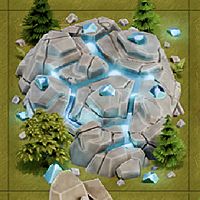
Gem VeinThere are 14 Gem Veins scattered throughout Legacy of Kings: Idle Builder where you can build a Gem Mines. |
You'll find 14 of these scattered across the map. The mining process is automatic, but you need to hit one of your mines once every 24 hours to collect.
Early on, the payout is pretty tiny, but it scales up as you progress. Plus, there are upgrades specifically designed to boost your Gem yield.
Story in Legacy of Kings: Idle Builder
On top of the standard progression, there’s a story track with dozens of optional quests and rewards. Don’t feel forced to focus on them; think of these as extra milestones that nudge your development in the right direction. Just knock them out whenever you have the chance.
Exploration Speed
Exploration Speed will be your main challenge in the game. As you move further away from the Capital, the required number of "clicks" increases. Of course, you don’t actually have to click repeatedly, just hold down your finger on mobile or the mouse cursor.
This click rate is your Exploration Speed. You can boost this through discoveries and upgrades. I managed to reach 620 Exploration Speed it is not the absolute cap, but it makes a massive difference, even if those map corners still took quite a bit of effort.
Capital - The heart of your kingdom
The Capital is the heart of your empire and the central point of the entire Kings: Idle Builder world.
CapitalYour Capital is easily the most vital spot in the game. It generates Coins and Workforce at the cost of Food, but its main job is setting your global tech level. |
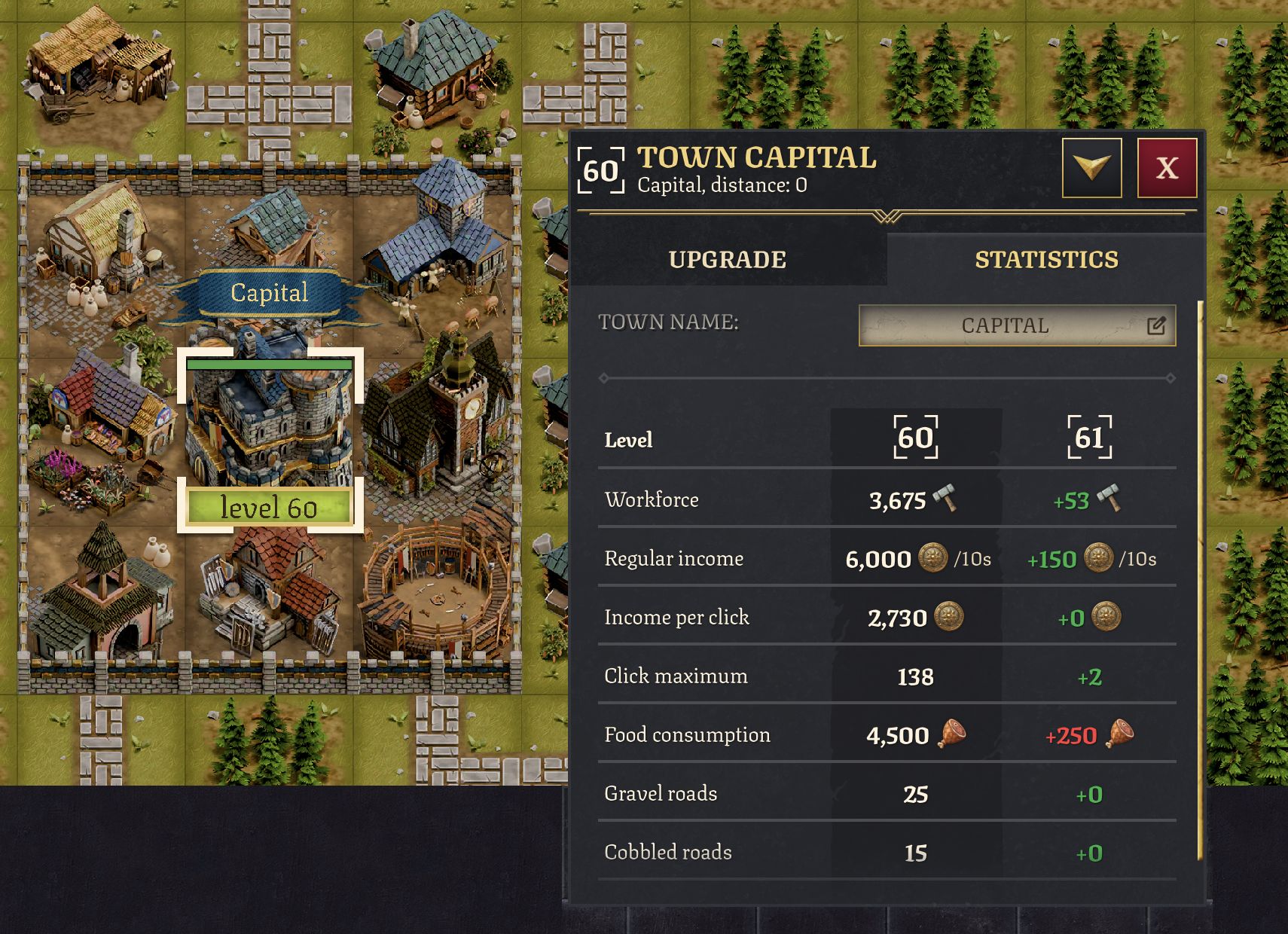
- The Capital sits right at the center of the world map.
- Its primary role is setting the tech level for your entire kingdom. Leveling up the Capital gives you access to new technology, buildings, and upgrades.
- Pushing your Capital's level higher is the main goal of the game.
- Beyond just resource costs, Capital upgrades require you to complete various tasks across the map.
- Aside from these special perks, the Capital functions just like any other Town.
- Right now, the level cap for both the Capital and Towns is 75. This isn't set in stone, though. The devs periodically raise the ceiling, introducing new buildings and upgrades to keep things moving.
Towns
Towns are the heart of your economy. They generate the bulk of your Coins and your entire Workforce, though they require a steady supply of Food to keep running.
|
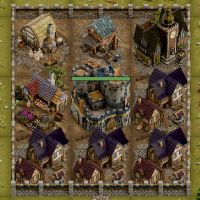
TownsThere are 115 Towns waiting to be discovered and brought into your fold across the world of Legacy of Kings: Idle Builder. |
- You’ll need to find all 115 Towns on your own (check the Town location map for help). To bring a Town into your kingdom, you must link it to the Capital through a network of Roads, Shipyards, or a mix of both.
- Towns have levels that you can increase by supplying resources and hitting specific milestones. Higher levels boost efficiency and revenue, making city upgrades a core part of your progression.
- Towns are your best source of Coins and the only way to gain Workforce, but they drain Food to stay operational. Both income and Food consumption scale up as the Town levels up.
- Each Town has eight building slots for various structures. The variety of buildings available expands as you raise your global tech level via the Capital.
- Developing your Towns increases your cap for Gravel and Cobbled Roads, which is vital for maximizing your income.
- You can manually collect taxes by clicking on a Town, but it’s hardly efficient and usually isn't worth the effort.
- Once captured, you won’t lose a Town unless you sever its connection to your road network.
Resources in Legacy of Kings
- Coins: The primary currency and your most basic resource, Gold Veins and Coral Reefs.
- Food: Keeps your community running. You'll get it through farming, ranching and Fishing.
- Workforce: Towns provide the people needed to keep your operations functional.
- Gems: The premium currency, Gem Veins.
- Lumber: Your basic building block, harvested from Forests.
- Stone: Quarried from Hills or Mountains.
- Clay: Dug up at Clay Pits found in Swamps.
- Iron: Extracted from Iron Mines located in Hills or Mountains.
- Goods: Items manufactured by processing other raw materials.
- Steel: Produced by smelting Iron.
- Army: Recruited and trained within your Towns.
Resource Distribution and Density Map.
Coins - How to earn Coins in Legacy of Kings?
Coins are the primary world currency and main resource. You'll need them for basically every construction project and upgrade. While there are plenty of ways to get your hands on them, they remain your most vital resource.

|
Coins, the primary currency in your Kingdom. You can earn them from various sources, but taxes are your main revenue stream. | |
Coins don't require storage space, and there's no cap on how many you can hold.
Primary ways to earn Coins in Legacy of Kings:
| Coins Source | Description |
|---|---|
Towns | These are your main revenue drivers (more than half of your total income). You collect taxes from your subjects, and as your city grows, so does your population and tax income. Upgrading Towns is a constant task throughout the game. You can collect Coins automatically or click the city manually (which is honestly exhausting and luckily not required). |
Explored Tiles | Every revealed tile grants 1 Coin per turn, regardless of what's on it. The larger your empire, the more Coins you pull in. This is your second most vital income source. |
Gold Mines | These stand as the third most important way to earn Coins. |
Advanced Roads | Cobbled and Gravel Roads, Tunnels, and Bridges are another major source of income. Make sure you've built the maximum number of Advanced Roads allowed (this limit increases with your Town level).
|
Pearl Hunters | Later in the game, you can build Pearl Hunting Boats. These provide a great steady stream of Coins. |
Universities | Build as many of these city buildings as you can. They don't drain important resources, yet they keep the Coins coming in. |
Other Town Buildings | A few other structures produce Coins, but they aren't game-changers. Most of them consume raw materials that you'll need for more important projects. |
Food
Food is a resource you need to maintain and grow your community. You have to produce it yourself since it can't be mined.

|
Food is vital for keeping your community alive and funding your upgrades. |
Most Food is consumed by Town Centers and Houses, though some is also used for production in Town workshops.
While there are plenty of ways to get Food, these are food heavy hitters:
- Bakery - A city-based building.
- Wheat Farm - Great for the early game. It's efficient but eats up a lot of space.
- Fishing Boats - These only really work as a solid Food source on high-density fishing spots. I’ll dive into the details later in this guide.
- Livestock Farm - The best and most space-efficient way to get Food, available once you hit the mid-to-late game.
As your empire grows, you can pretty much ignore every other production method.
Workforce
Workforce is the resource you pull from the people living in your Towns.

|
Workforce, everything you own needs people to run it. |
You'll need Workforce for basically everything. In my experience, Mines were the biggest drain on it. There’s only one way to grow your Workforce: you have to discover new Towns and expand them while keeping up with their high Food requirements.
Gems
Gems are completely optional resource, but they definitely take the edge off the grind.

|
Gems are the premium currency in Legacy of Kings. |
You can buy Gems in the in-game shop with real money. Honestly, I wouldn't recommend it, or you might end up playing the most expensive game of your life. There’s basically no limit to how many Gems you could burn through, you’d need tens of thousands just to breeze through on easy mode. On the flip side, making a purchase is a nice way to support the devs since this is how they make a living.
You can also pull Gems for free by building Gem Mines on Gem Veins. There are 14 of these spots in total. Each one grants 1 Gem per day, but you can pump those numbers up with upgrades.
The best way to spend your Gems is on permanent Upgrades. My personal favorites are the ones that let you build structures without needing to connect them to roads.
Lumber
Lumber is the first and easiest resource to grab. Just find a Forest and build a Lumber Mill there.

|
Lumber, a resource needed to build various buildings and to upgrade towns. Lumber Mill produces lumber from surrounding forests. | |
The amount of wood you get depends on how thick the trees are, but you can always plant your own forest if needed. Try not to let the work areas of your Lumber Mills overlap, otherwise you’ll end up with a wasteland. I usually space them out so they don't share any tiles, though you can technically get away with two mills working the same spot.

|
Old ForestOld Forest is your best bet for lumber, food, and hides, yielding five times more than a standard forest. Take care of these areas and avoid placing multiple Lumber Mills on a single Old Forest tile, since you might clear-cut it completely. Stick to a maximum of two Lumber Mills per tile. |
You’ll mostly use lumber to expand and upgrade buildings, but it’s also vital for the various workshops you can set up in Towns.
One particularly handy upgrade lets you build Lumber Mills away from roads, which makes grabbing wood a lot easier.
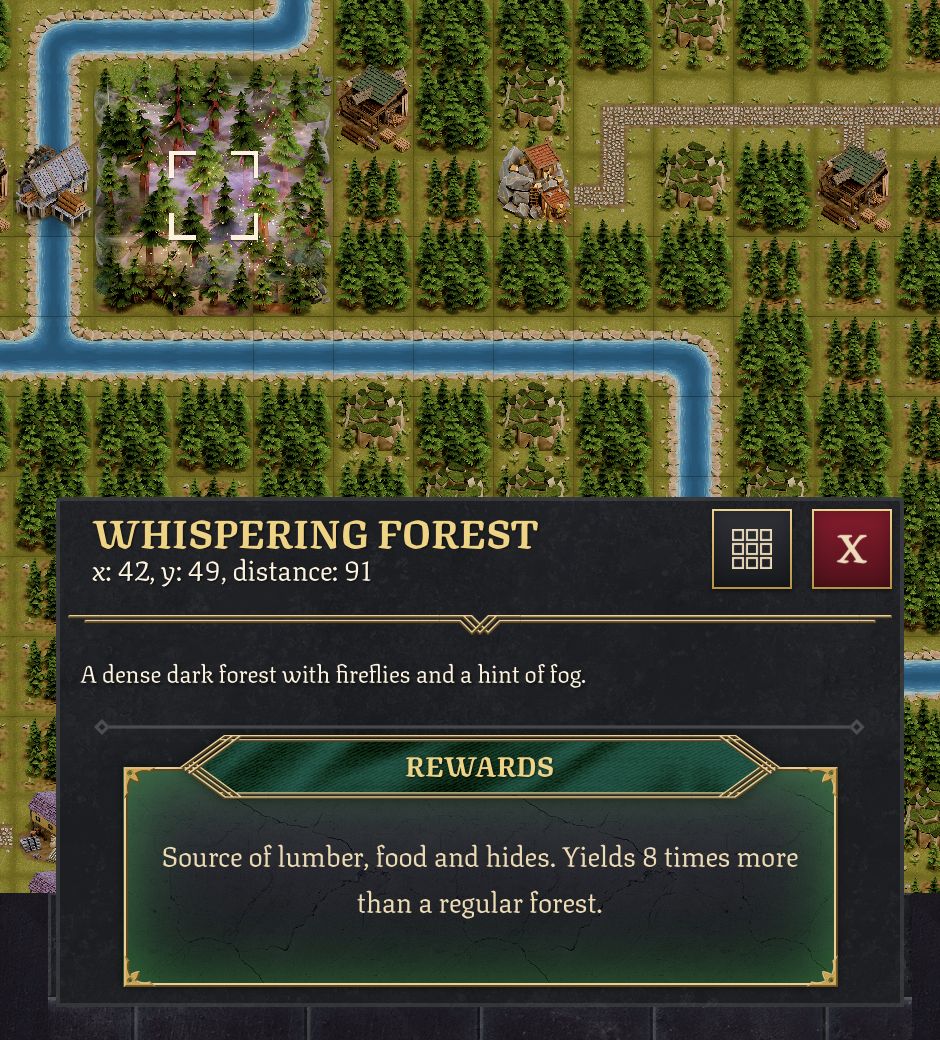
Whispering Forest - LandmarkThis magical spot is a goldmine for lumber, cranking out eight times more than a regular forest. Just make sure it’s within range of your Lumber Mills. You can go heavy on the buildings here, as it looks like you can't actually clear-cut the Whispering Forest to the ground. |
Stone
Stone is easy to find and vital for both building and upgrading your Towns.

|
Stone is easy to come by, just set up a Stone Quarry on Hills or Mountains. |
You can extract Stone using a Quarry or Large Stone Quarry on Hills or Mountains.
It’s an easy resource to find. Keep in mind that if you build one mine next to another, you won't need a road. I usually drop Stone Quarries on empty tiles around Iron Mines just to fill the gaps.
The main upgrade for Stone Quarries is the Ox Stable, which boosts Stone production in the surrounding area by 50%.
Clay
Clay is tougher to track down since you can only extract it from Swamps, which are tucked away in specific spots across the map.

|
Clay - Just set up a Clay Pit on a Swamp to start digging. |
Pulling enough Clay can be a real headache. Swamps, where you place your Clay Pits, aren't spread out evenly on map. Aside from the occasional lone tile, you'll find three major clusters and a few smaller ones on whole map. Check the Resources Map to track them down.
You'll need a ton of Clay for most structures and Town upgrades starting around the mid-game. For me, this was the first resource to run dry, and it stayed that way for most of my playthrough.
Iron
Iron is easy enough to find resource, but the real kicker is that you're going to need a massive amount of it.

|
Iron, to produce this resource, place a Furnace near mountains and build Iron Mines within its radius. |
In the world of Legacy of Kings: Idle Builder, Hills and Mountains are quite common, so finding locations for Iron Mines is straightforward. Each Iron Mine supplies iron ore to a nearby Furnace. A single Furnace, which has a range of two tiles, can support multiple Iron Mines. The Furnace is the structure responsible for producing the finished Iron.
You will require a vast amount of Iron, as it is utilized not only for construction and Town upgrades but also for the production of Steel and Goods. Eventually, your mountain ranges will be largely covered by mining operations.
|
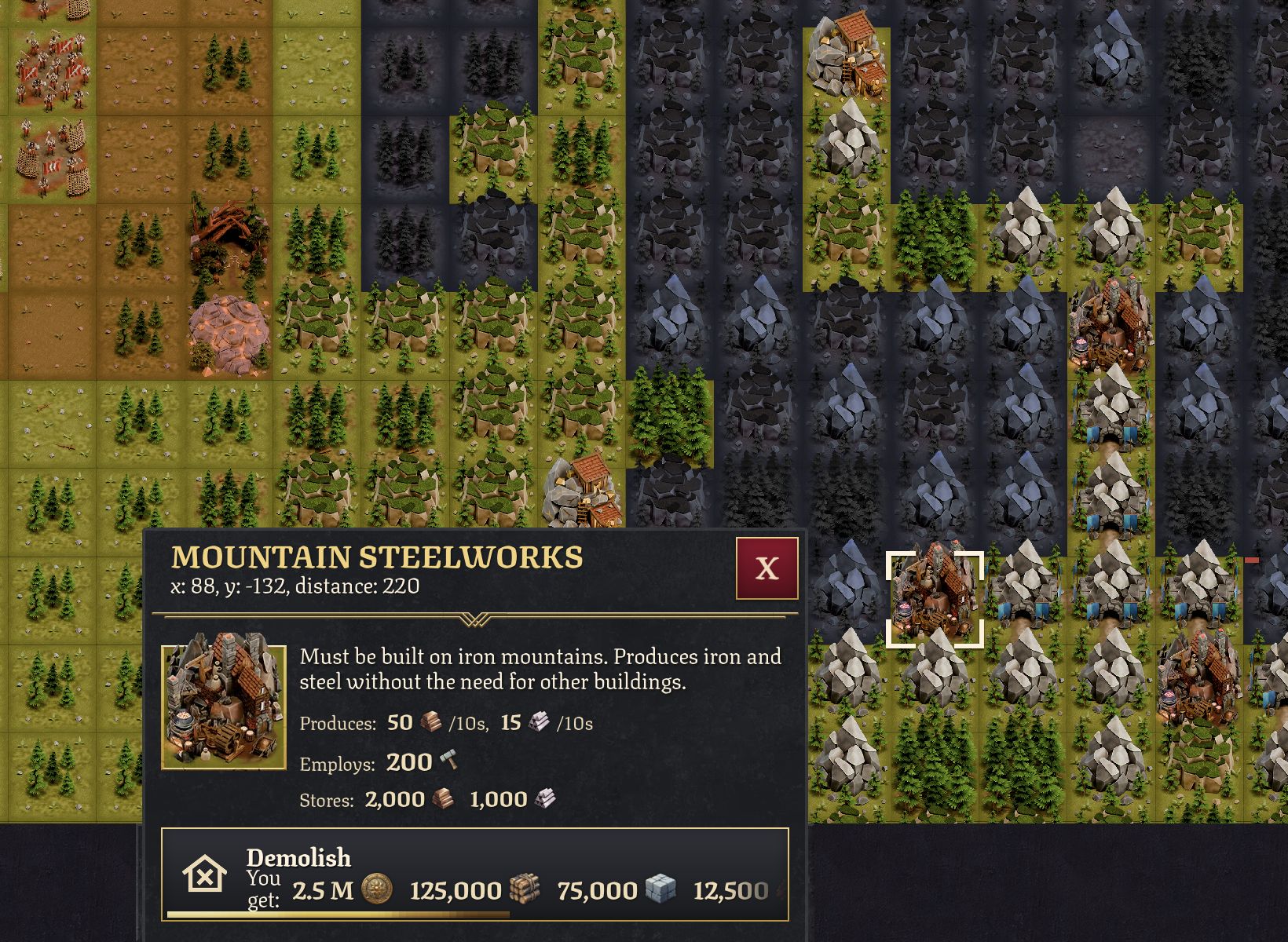
Iron MountainIron Mountain is unique location designated for the construction of Mountain Steelworks. |
Mountain SteelworksSpecial method for producing Iron involves locating Iron Mountains at the edges of the map. There are 19 such locations, typically situated in remote or difficult-to-reach areas. In these spots, you can construct Mountain Steelworks, which serve as an efficient source of both Iron and Steel without the requirement for additional supporting structures (you will still need road). |
Goods
You can't mine Goods like other resources. Instead, you have to craft them using raw materials.

|
Goods are made from other resources in the workshops you build in Towns. |
Goods aren’t something you can just dig out of the ground. You get them by processing materials in Town Workshops.
Several buildings handle production. Basic spots like the Blacksmith or Tailor’s Workshop get the job done, but advanced options like the Toolmaker are much more efficient.
You’ll need Goods to construct buildings, upgrade Towns, and keep your Army supplied. You can also head to the Marketplace to sell your Goods and turn them into Coins.
If you’re running low, keep an eye out for Merchant Ships and Traveling Merchants in various locations.
Steel
Steel is a high-tier resource made by smelting Iron at the Foundry.

|
Produce Steel at the Foundry using Iron from your Furnace. You can even hook up multiple Foundries to a single Furnace to keep things moving. |
Steel is an advanced material produced by processing your existing Iron.
Beyond construction of builidings and upgrading Towns, its main use is for your Army.
To get Steel, place a Foundry or Industrial Foundry next to an active Furnace. You can cluster several Foundries around a single Furnace if needed.
The Mountain Steelworks mentioned in the Iron section serve as another source.
The real challenge with Steel is the constant drain on your Iron reserves, which usually leads to a shortage.
Army
Army is the last resource on your list.

|
Train your Army at the Barracks, but you'll also need an Armory to keep your troops geared up. |
You'll need an Army to upgrade Towns at higher levels. Their other main job is clearing bandits and pirates from newly discovered spots, where they just sit and hold territory. Despite what the in-game descriptions say, your Army doesn't actually defend your towns, there's just no need for it.
Build your Barracks in Town to start training troops, but make sure you have an Armory in the same Town to keep production moving.
Your total Army capacity depends on having enough housing across all your buildings, regardless of where they were trained.
Later on, you'll unlock the Archery Range and Fletcher building to recruit more Army and to take on Hostile Armies, but that’s a long way off, so don't sweat it for now.
Gold Veins and Gold Mines
While gold mining is a significant source of coins, keep in mind that Town development will generate at least twice that amount.
|
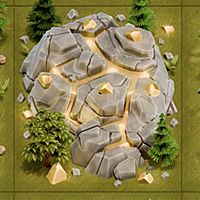
Gold VeinThe map features roughly 300 Gold Veins where you can build Gold Mines, mostly located in mountainous terrain. |
To extract gold from a Gold Vein, you need to place a mine on top of it.
There are two types of gold mines available:
- Gold Mine: Requires a road connection, offers standard output, and is easy to build.
- Premium Gold Mine: Doesn't require a road, provides a significantly higher yield, and is purchased with Gems.

Coral Reefs and Pearl Hunters
Later in the game, at higher levels, you'll start finding Coral Reefs across the ocean. These are the maritime equivalent of Gold Veins and serve as a source of coins.
There are over 60 Coral Reefs scattered throughout Legacy of Kings: Idle Builder.
To harvest pearls and convert them into coins, you must station Pearl Hunter ships there. Note that the number of Pearl Hunters isn't restricted by your Fishing Boat limit.

Fishing
Fishing is one of major Food source, and some quests will require you to hit specific Food production targets through it. It pays to spend some time learning the ropes.
You catch fish using Fishing Boats. Your fleet size is limited, dictated by the number of Shipyards you own.
Early on, when your ocean access is limited, you’ll find scattered Small and Medium Fish nodes. These are fine for getting started, but you can ignore them later. Shift your focus to Big Fish, specifically areas where multiple nodes cluster together. You can spot these prime spots on the Fishing Map.
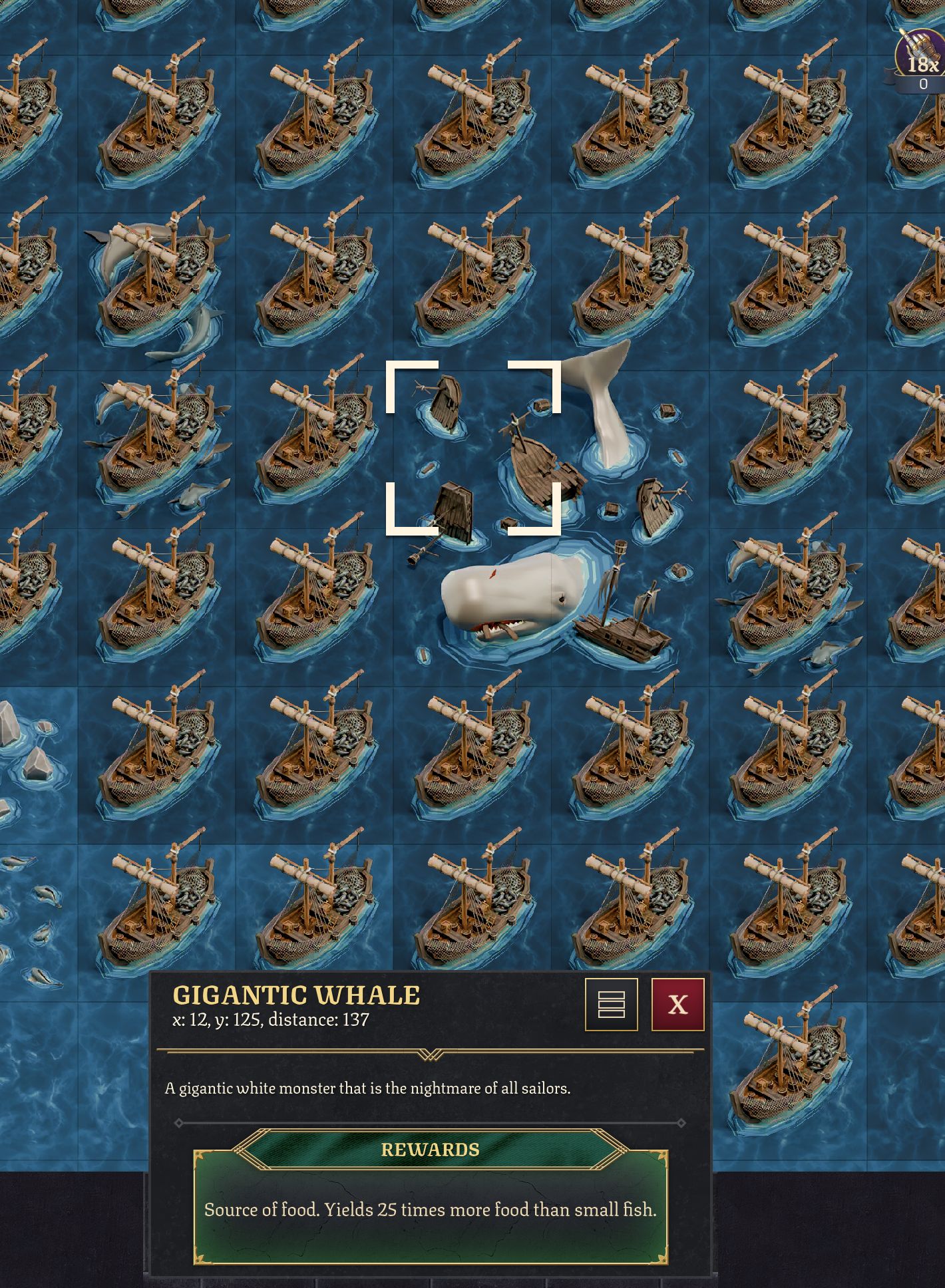
The biggest secret here is that a Big Fish node can support any number of Fishing Boats within its range without being overfished. Once you find a rich spot, pack it with as many boats as possible. A Fishing Boat doesn't need to sit directly on the Big Fish node to work, it just needs to be within reach.
Gigantic WhaleBest fishing spot, great source of food, yields 25 times more food than small fish. |

Resource Storage - Warehouses
Every mine, farm, workshop, or production building has its own small storage, but it fills up fast. To tackle larger projects, like Capital upgrades, you'll need extra storage to stockpile resources.
- Small Storehouse: Affordable and unlocked early on. It stores Lumber, Stone, and Clay.
- Warehouse: Becomes available later in the game. It handles Iron, Goods, and Steel.
- Universal Warehouse: The top-tier option. It costs 200 Gems but stores all resource types, adds 5 Workforce to your pool, and doesn't require a road connection.
You can chain warehouses together or place them next to other buildings, meaning you only need one road connection for the whole cluster.
Upgrading your storage capacity is vital—it's easily one of the most important upgrades you can make.
Don't be overwhelmed by the number of warehouses you'll need to build. Since you'll want large, flat areas for Wheat and Livestock Farms, try tucking your warehouses into narrow, peripheral spaces instead.

Landmarks, Wonders and Monuments
Exploring the world of Legacy of Kings: Idle Builder reveals plenty of unique spots like Landmarks, Wonders and Monuments. Finding these sites rewards you with loot, new skills, or stat boosts. Check All Secret Locations Map every hidden secret, including their locations, names, descriptions, and the bonuses they provide.

Roads
Every structure in your Empire needs a connection via roads or sea routes.
Upgraded roads are vital since they cost nothing to maintain while generating passive income.
- Each Gravel Road (including bridges) grants +6 Coins
- Each Cobbled Road (including bridges) grants +20 Coins
Shipyards and Naval Travel Range
Your maximum naval travel distance depends on the number of Shipyards you own, so build them along the coastline as you explore. This range is always calculated from the nearest Shipyard. Eventually, you’ll have enough of them to cover the entire map.
While the open ocean counts as a single body of water, smaller lakes are treated separately, so you’ll often need more than one Shipyard there.
Another key function of Shipyards is establishing sea connections that act as an extension of your roads.
Sea Connections
Sea connections between Shipyards function just like roads. To connect two Towns on different continents, build a road from the first city to the coast, place a Shipyard at the end, and then set up another Shipyard on the opposite shore with a road leading to the second city.
Hidden Treasures, Treasure Maps and Chests
While exploring the map, you’ll stumble upon numerous spots that need "clearing," including:
- Abandoned Hut
- Bear's Den
- Burnt House
- Castle Ruins
- Mercenary Camp
- Mercenary Ship
- Merchant Ship
- Neglected Field
- Old Battlefield
- Shipwreck
- Travelling Merchant
- Wolf Den
Clearing these spots grants resources, coins, speed-ups, gems, or other bonuses. It’s always worth the effort.
More importantly, each time you clear a tile, it boosts your chance of finding a Treasure Map that reveals the location of a nearby Treasure Chest.
Every Treasure Chest contains a solid bonus.
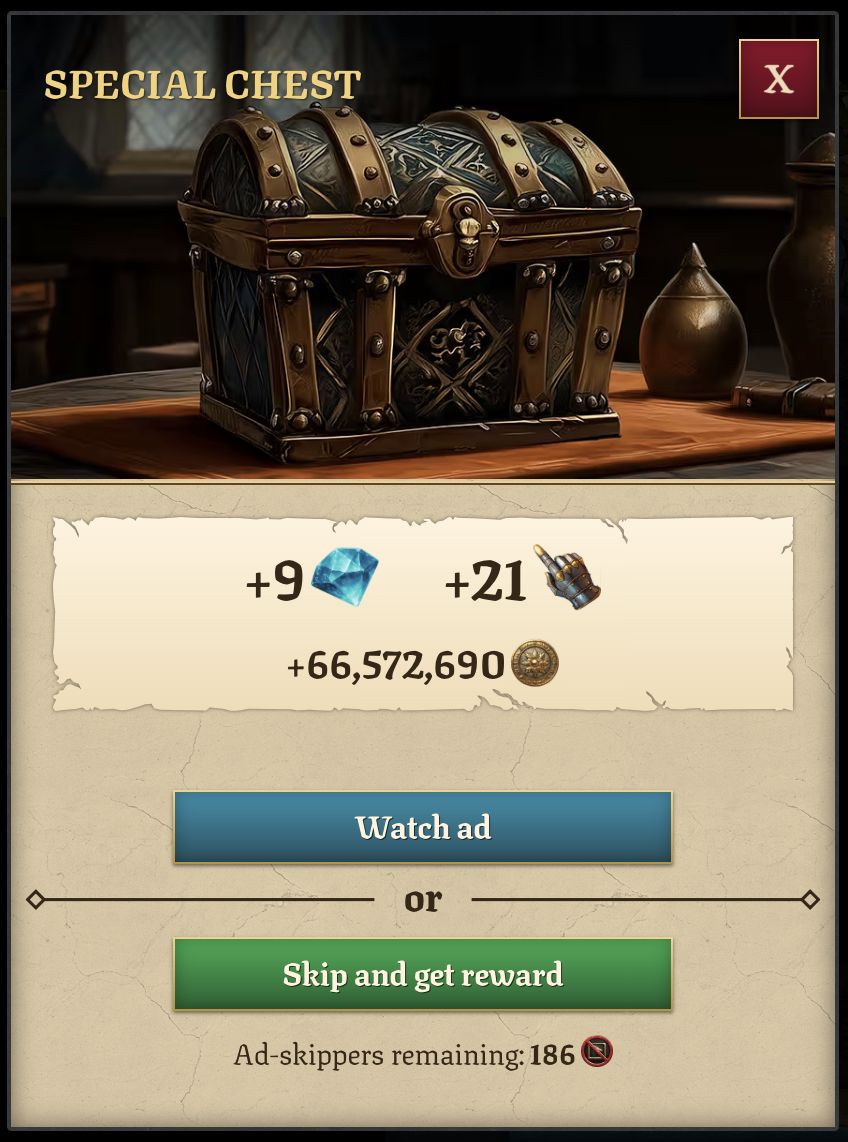
Once every 24 hours, you can track down a Special Chest where the rewards are substantial and scale up with your level.
Special ChestThe Special Chest offers a massive bonus once every 24 hours. |
Offline Earnings
You’ll generate Coins and Resources at the fastest rate while actively playing.
You can boost your active income up to three times for 5-minute intervals, several times a day, by watching ads.
The game includes "Idle" in its title for a reason you still earn while away. It’s a slower process, but you can increase your offline income through upgrades and extend the duration up to 6 hours. It’s a solid way to grow your wealth.
Legacy of Kings: Idle Builder Game Info
| Game Box | Description |
|---|---|
|
|
|
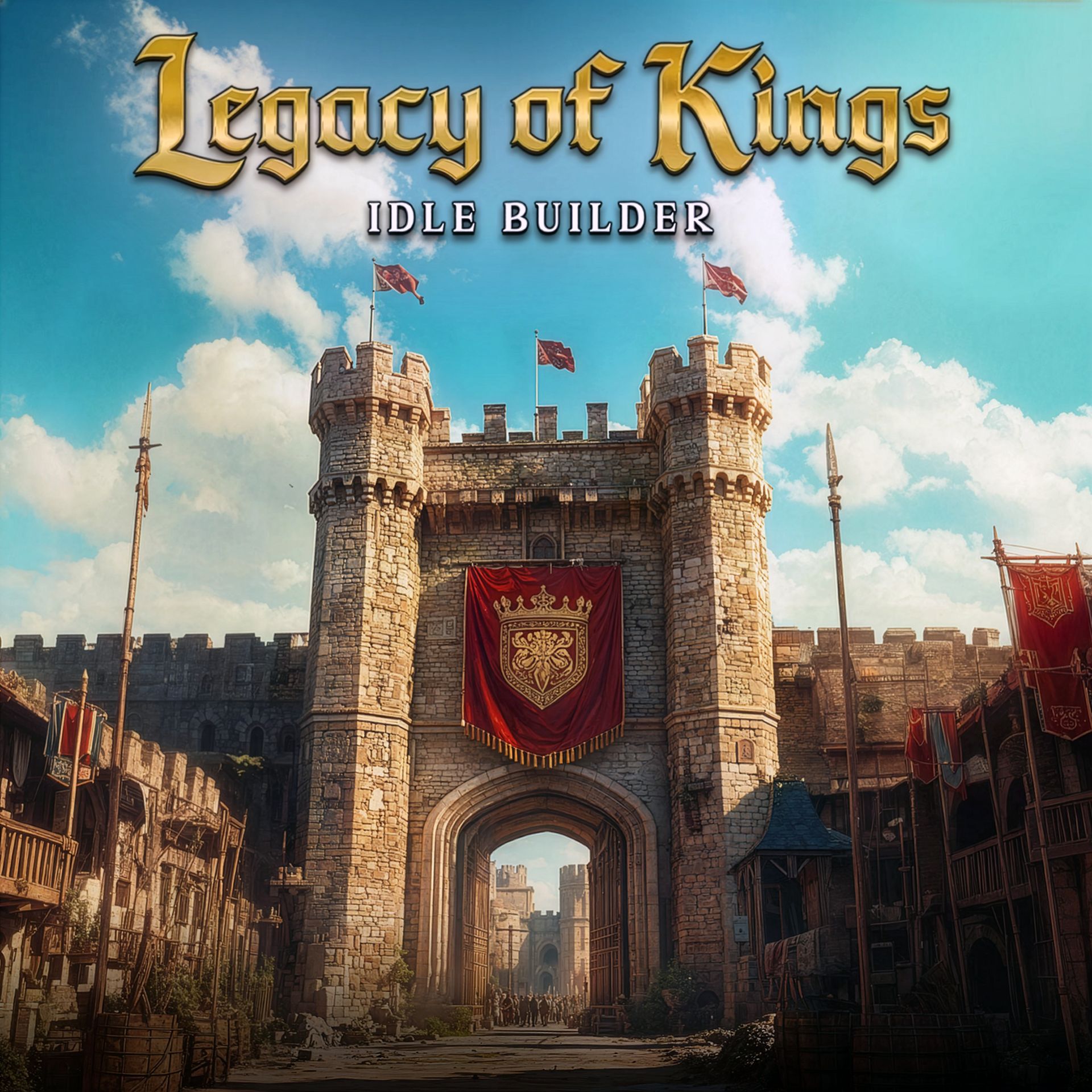
You’re the rightful heir to a broken throne, and it’s time to stop mourning the past and start building the future. Your family’s legacy is in ruins, and your job is to turn a shattered kingdom back into a powerhouse. This isn’t just about clicking buttons; it’s about managing a living medieval economy, from small workshops to massive mines, all while making sure your people don’t starve. Legacy of Kings mixes classic kingdom management with idle mechanics, so your empire keeps growing even when you’re away. You’ll need to unify divided regions, fix broken supply chains, and automate your production to keep the gold flowing. It’s a slow-burn strategy game that lets you expand at your own pace, uncovering hidden lands and reclaiming what was stolen from your bloodline.
| |
User Comments
All your comments, suggestions and corrections are very welcome. Your experience in the game will help other players. I will read each of your comments and try to add to the content on this page based on them. Thank You.